GTA 6 vs GTA 5 Graphics: A Frame-by-Frame Technical Breakdown
Lighting, NPC density, water, vegetation, character detail and draw distance compared between GTA 6's two trailers and GTA V's 2013 and Enhanced builds.
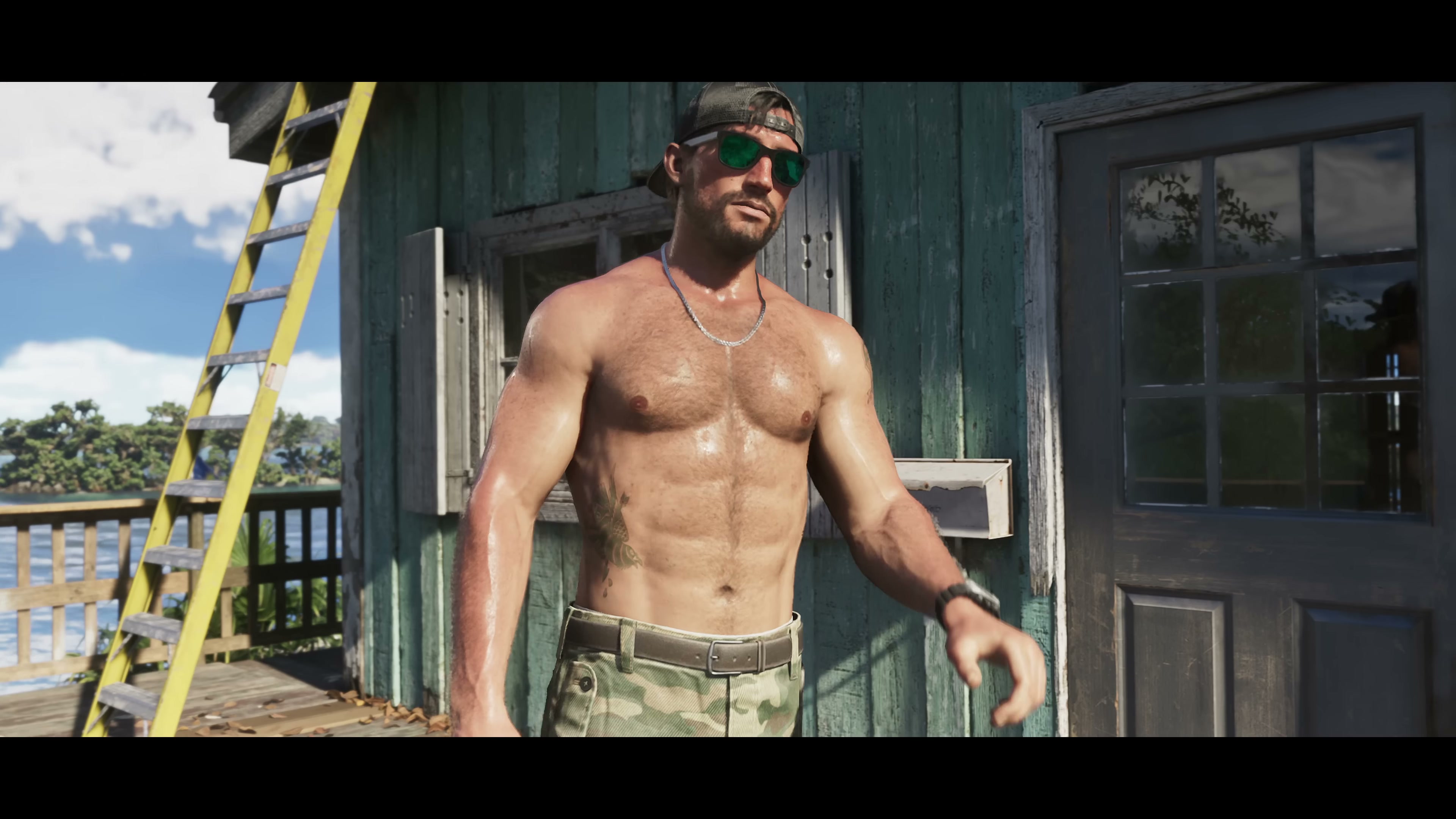
Trailer 2 at 0:23 — pore-level skin shading, sub-surface scattering on the ears, and individually rendered chain links mark a generational jump over GTA V's stylised character models.
Grand Theft Auto VI Trailer 2 · timestamp 0:23 · © Rockstar Games / Take-Two Interactive · Reproduced for editorial commentary under fair use. Retrieved May 21, 2026.
Grand Theft Auto V shipped on PS3 and Xbox 360 in September 2013, received an Enhanced edition for PS4/Xbox One in 2014, and was uprezzed again for PS5/Xbox Series in 2021. Across all three SKUs the underlying RAGE pipeline stayed broadly recognisable — same character rig topology, same baked global illumination, same water shader family. The two GTA 6 trailers released in December 2023 and May 2025 show a rendering stack that has been re-built rather than patched. This breakdown compares the publicly visible frames against what GTA V actually delivered, system by system, citing where independent tech analysts have isolated the same differences.
The scope here is strictly visual rendering. Gameplay systems, AI behaviour and audio are out of frame. Where a claim isn’t directly observable in trailer footage, it’s flagged as community attribution rather than confirmed Rockstar information.
1. Character rendering and skin shading
The single most visible jump between the two games is what happens to a human face in close shot. GTA V’s 2013 model budget was approximately 12,000 triangles per protagonist with three LOD steps, and the Enhanced release in 2021 added higher-resolution textures without changing the underlying rig. GTA 6’s close-ups show pore-level micro-displacement, individually shaded eyelashes, and visible sub-surface scattering on translucent tissue (ears, nostrils, lips).
Trailer 2 at 0:23 — the close-up of Cal Hampton on the deck of his cabin — is the cleanest reference frame for this. Digital Foundry’s tech breakdown described the upgrade as a “gigantic upgrade in character rendering” at 27:11 of its analysis, noting that the increase shows across both hero models and incidental NPCs. Lucia’s interior shot in Trailer 1 at 1:02 confirms the same pipeline applies in motion, with fabric weave on the bandana and stray hair strands rendered as discrete geometry rather than alpha-tested cards.
| Rendering feature | GTA V (2013) | GTA V Enhanced (2014/2021) | GTA 6 (T1 / T2 footage) |
|---|---|---|---|
| Per-protagonist polygon budget | ~12k tris | ~12k tris, higher-res textures | Visibly higher density; eyelashes/hair as geometry |
| Skin sub-surface scattering | None (baked AO only) | None | Visible on ears, nose, lips in direct sun |
| Eye rendering | Single sphere, baked highlight | Single sphere, slightly improved spec | Cornea refraction, parallax iris, wet meniscus |
| Pore detail in close-up | Diffuse texture only | Diffuse texture only | Micro-displacement / detail normal map |
| Background NPC fidelity gap | Severe LOD drop | Severe LOD drop | Narrower — see DF at 27:11 |
The narrowing of the gap between hero and crowd character quality matters because it constrains how often the game can put a camera into a crowd without revealing the engine’s seams. GTA V routinely cut away when too many NPCs entered a shot. The Trailer 1 prison-yard frame at 0:06 holds a wide crowd in a single take.
2. Lighting, HDR and time-of-day
GTA V used pre-baked global illumination plus a dynamic sun term, with screen-space ambient occlusion layered on top. Reflections were almost entirely screen-space (SSR), with a small set of cube-map probes for vehicle paint. The 2021 Enhanced release added ray-traced reflections in a “Fidelity” graphics mode but kept the same lighting solver underneath.
GTA 6’s two trailers consistently show real-time global illumination behaviour that the Enhanced build never reached. The sunset dock shot in Trailer 2 at 1:23 demonstrates the difference clearest: warm light bouncing onto the underside of the dock planks, secondary blue fill from the open sky on shadowed sides, and a soft volumetric haze that occludes the horizon rather than simply darkening it. INTER’s graphics breakdown noted at 8:33 that exposure is now driven by environmental conditions rather than a fixed tonemap, which is consistent with the cabin interior of Trailer 1 at 1:16 — bright exterior bloom clipping through the door glass while interior shelves remain readable.
| Lighting subsystem | GTA V (2013) | GTA V Enhanced (2021) | GTA 6 trailers |
|---|---|---|---|
| Global illumination | Baked, static | Baked + RT GI in Fidelity mode (limited radius) | Appears fully dynamic across hours |
| Reflections | SSR + cube maps | RT reflections (Fidelity mode) | RT reflections in side mirrors (T1 + T2) — INTER at 1:45 |
| Sky model | Skybox + sun term | Same | Physically-based, time-driven scattering |
| Volumetric atmospherics | Light shafts only | Light shafts | Volumetric haze, distance fog with density variation |
| Auto-exposure | Fixed per area | Fixed per area | Environment-driven — INTER at 8:33 |
Digital Foundry’s analysis cautioned that some shots in earlier promotional footage appeared to still use SSR with visible artefacts at 21:23, and noted at 22:11 that ray-traced reflections “can only show what’s actually captured in the BVH,” so there are still memory-budget trade-offs being made. This is not a fully path-traced game; it is a hybrid renderer making smart choices per shot.
3. Water simulation
GTA V’s water surface was a tiled wave heightmap with a Fresnel-blended SSR layer. Boats produced decal-based wakes that faded within a few seconds. Underwater visibility was a uniform blue-green fog regardless of depth.
The Trailer 1 aerial yacht shot at 0:10 shows three behaviours that GTA V never delivered together: refractive transparency revealing the sandy seabed in shallow water, persistent twin wake trails extending behind the hull, and depth-graded colour shift as the seabed slopes away. The speedboat chase at 0:23 of the same trailer shows compounded wakes from multiple craft interacting. Digital Foundry singled out at 19:47 the smaller-scale fluid behaviour — beer sloshing in glassware, water in containers responding to movement — as evidence of a unified fluid system rather than the pre-baked liquid props GTA V used.
| Water behaviour | GTA V | GTA 6 trailers |
|---|---|---|
| Surface wave model | Tiled heightmap | Tiled + interactive deformation around vessels |
| Wake persistence | Decal, fades quickly | Visibly persistent twin wakes — T1 at 0:10 |
| Underwater clarity | Uniform fog | Depth-graded, refractive shallows |
| Interaction with small containers | Pre-baked props | Dynamic — DF at 19:49 |
| Reflection method | SSR + cube map | RT reflections where visible |
4. Vegetation, draw distance and skyline
The bridge aerial in Trailer 1 at 0:35 is the most useful frame for assessing draw distance and vegetation density. The causeway holds sub-pixel detail at extreme range, individual palm trees populate the island chain with no visible billboard transition, and the seaplane in the foreground sits cleanly against the LOD horizon. The opening highway shot at 0:02 carries the same load against a sunset sky — a full city skyline holds at distance with palm trees populating the median.
GTA V’s draw distance budget was set against PS3 memory constraints in 2013. The Enhanced builds extended it but never broke the underlying LOD step structure, which produced visible “pop-in” rings around the player on consoles. The Trailer 1 aerial frames don’t show those rings. The trailers don’t, of course, prove what happens during actual gameplay at sustained 60 fps — Digital Foundry explicitly noted at 3:43 that trailers can’t be judged the same way as real-time output, and that no public footage has confirmed a sustained native 4K / 120 fps target.
| Environment metric | GTA V (Enhanced) | GTA 6 trailers (observed) |
|---|---|---|
| Vegetation instance count per frame (visual estimate) | Hundreds | Thousands — see T1 0:35 |
| Visible LOD pop ring | Yes, around player | Not visible in trailer cuts |
| Palm tree shading | Card-based with normal map | Geometric fronds with translucency |
| Skyline LOD steps | 3–4 discrete | Continuous transition |
| Bird/wildlife in background | Sparse | Multiple flocks visible in T1 0:02 and T2 1:23 |
5. Cross-trailer comparison
Some rendering features are shown in both trailers, which helps separate “trailer-only” cinematics from systems that consistently work across showings.
| Feature | Trailer 1 timestamp | Trailer 2 timestamp | Notes |
|---|---|---|---|
| Volumetric sunset sky | 0:02, 0:35 | 1:21, 1:23 | Identical physically-based behaviour across both trailers |
| Water with depth refraction | 0:10, 0:23 | Sunset waterfront 1:21 | Consistent shader behaviour |
| Real-time mirror reflections | Vehicle interiors 1:00, 1:02 | Multiple scenes — INTER at 1:50 | T2 shows more frequent use |
| Close-up character skin | Lucia interior 1:02 | Cal close-up 0:23 | Same sub-surface model |
| Interior-to-exterior light blending | Convenience store 1:16 | Cabin / dock scenes | Auto-exposure adapts per shot |
| Dense crowd rendering | Prison yard 0:06 | Various street scenes | Background NPC LOD gap visibly narrower |
The recurrence of these features across two trailers shot eighteen months apart, with at least one of them clearly using newer in-engine captures, makes them more defensible as systemic engine capabilities rather than one-off cinematic frames.
6. What independent tech analysts have flagged
Three creator analyses in the public record provide cross-verification of the differences listed above.
- Digital Foundry’s tech breakdown (35:32) framed the trailer as a deliberate showcase of “both character rendering and environmental details,” and at 27:11 isolated character rendering specifically as the biggest single upgrade. At 22:11 the same analysis cautioned that RT reflections are budget-bound by what fits in the BVH, which explains why some windowed reflections in lower-traffic scenes still show SSR-like artefacts.
- INTER’s graphics breakdown focused on micro-detail: at 0:14 the beer-bubble shot inside Jason’s living room, at 1:50 the multi-scene confirmation of real-time mirror reflections, and at 8:33 the dynamic auto-exposure adapting to the Florida sun. These are not isolated cherry-picks — they re-appear across trailer scenes shot in different locations.
- The Game Theorists (2:47) used the trailers primarily for narrative analysis but corroborated that the December 2023 trailer is being treated by the wider community as in-engine reference material rather than pre-rendered marketing footage. This affects how seriously the visual claims should be taken.
7. Still unverified / open questions
Trailers, even Rockstar’s in-engine trailers, are not gameplay. The following remain explicitly unconfirmed by public material as of this writing:
- Target frame rate at retail. No officially confirmed framerate target across platforms. Digital Foundry noted at 3:43 that no 4K/120 footage has been publicly released; the trailers run at 30 fps on YouTube which prevents direct cadence analysis.
- Whether RT reflections are always-on or quality-mode only. GTA V Enhanced split RT between Fidelity and Performance modes; GTA 6 trailers don’t indicate which mode the captures used.
- Crowd density during actual gameplay. Trailer cuts hold dense crowds, but cinematic shots can stage NPCs that wouldn’t normally co-spawn in open-world play.
- PC version rendering ceiling. No PC-specific footage has appeared. Historically, Rockstar’s PC builds have shipped 12–18 months behind consoles.
- Interior occlusion budget. The convenience-store-to-street transition at T1 1:16 is brief; whether interiors and exteriors share a single seamless scene at full draw distance is not confirmed.
- Pedestrian and traffic AI density vs visual density. The two are independent — visible NPC count in a trailer cut doesn’t fix how many simulated AI agents the engine carries during real play.
For deeper dives on related visual material, see the Trailer 1 frame-by-frame overview, the Trailer 2 expanded location tour, and the Vice City location breakdown. For confirmed platform information including release window and console availability, see the main GTA 6 release date entry.
The conservative summary: every rendering subsystem visible across the two trailers shows a generational step over GTA V’s Enhanced build, not an incremental one. The questions that remain are about consistency at retail — whether what holds in a curated trailer cut also holds in a player-controlled open-world scenario at 60 fps. Those answers won’t arrive until the game ships.
Gallery
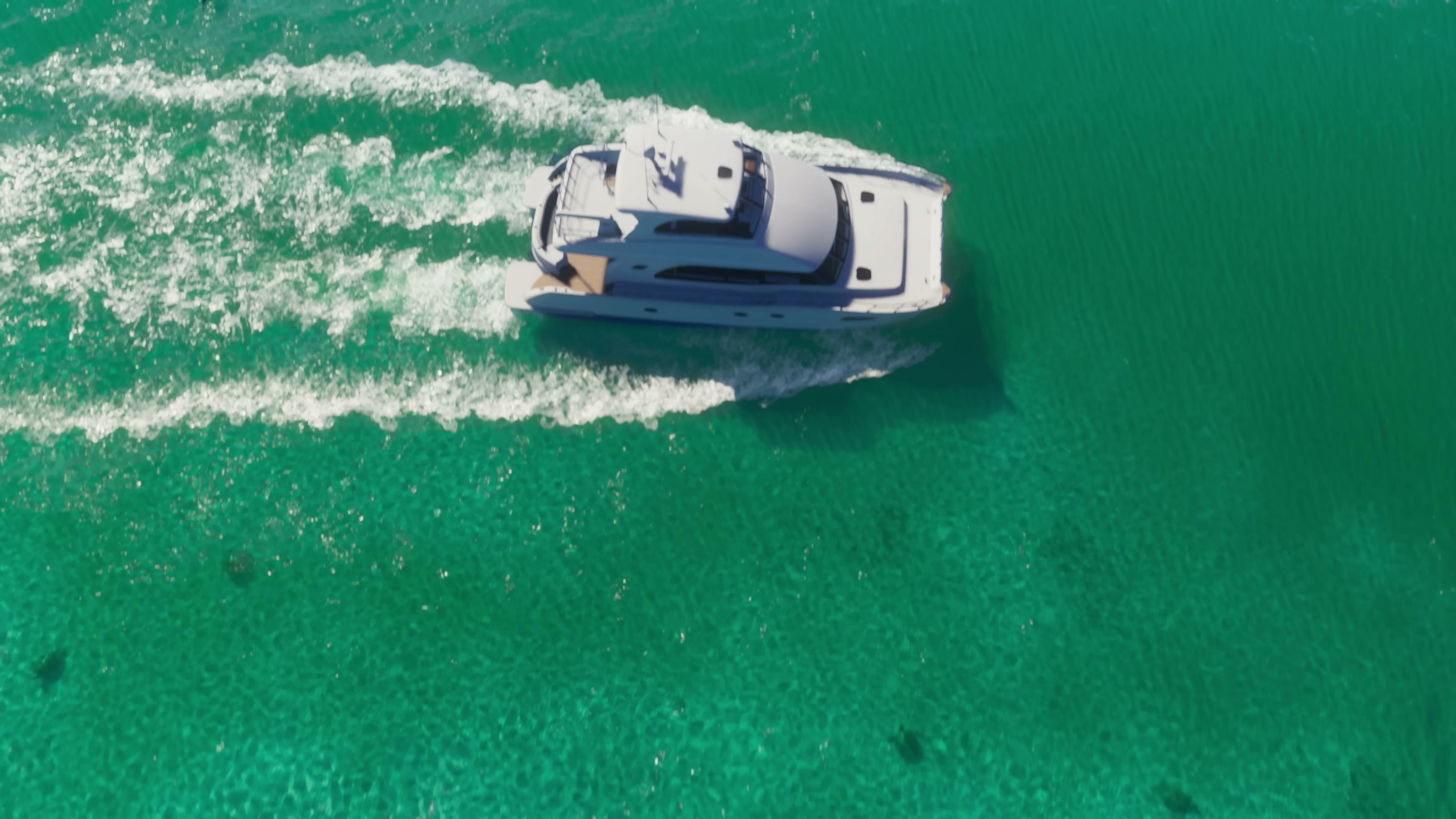
Trailer 1 at 0:10 — refraction reveals the seabed through the water column while persistent twin wake trails extend behind the yacht, a simulation step GTA V's water never attempted.
Grand Theft Auto VI Trailer 1 · timestamp 0:10 · © Rockstar Games / Take-Two Interactive · Reproduced for editorial commentary under fair use. Retrieved May 21, 2026.
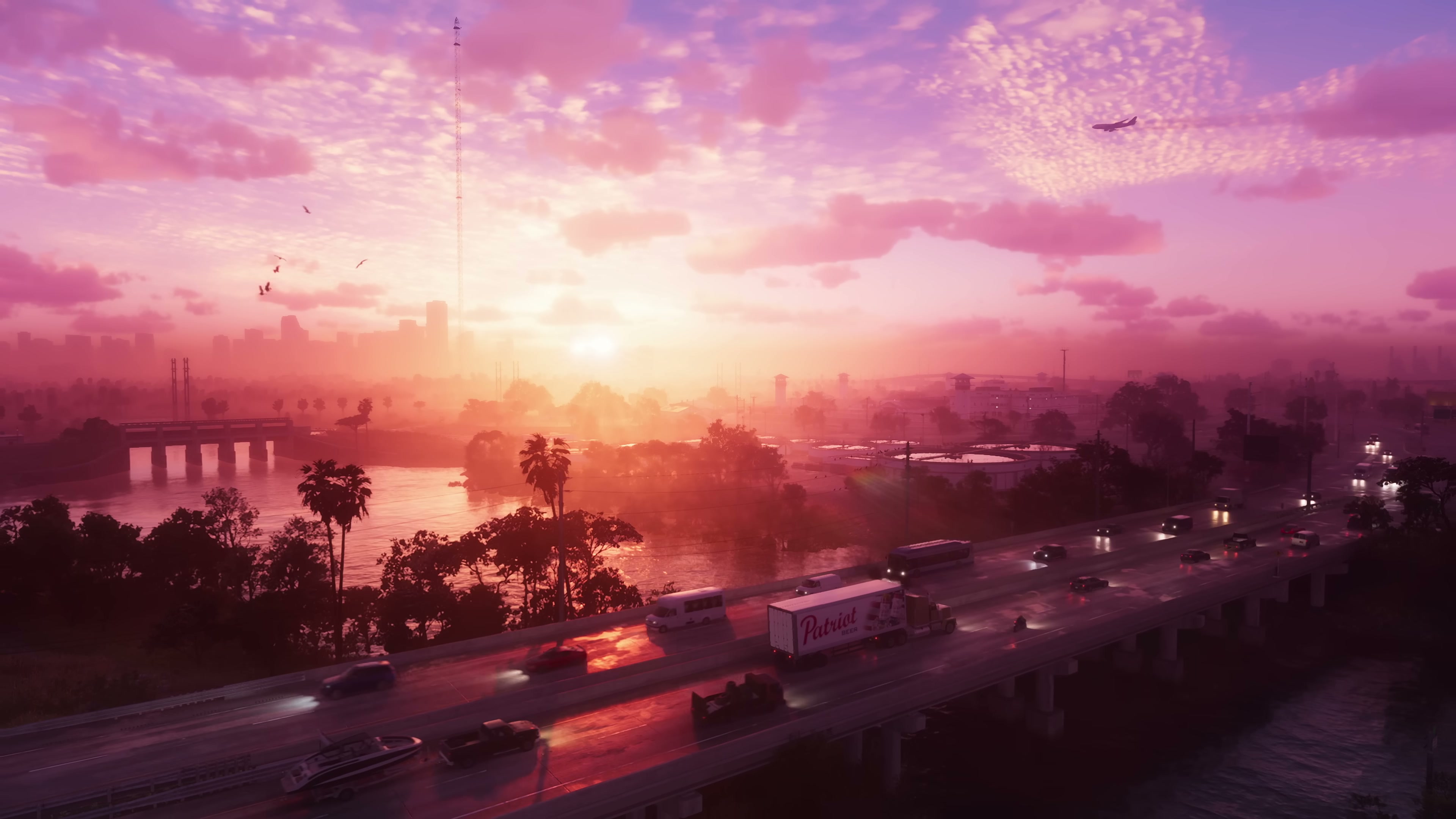
Trailer 1 at 0:02 — long-distance atmospheric haze, volumetric sun shafts, and a densely populated skyline indicate a far higher LOD ceiling than Los Santos hit even in the Enhanced build.
Grand Theft Auto VI Trailer 1 · timestamp 0:02 · © Rockstar Games / Take-Two Interactive · Reproduced for editorial commentary under fair use. Retrieved May 21, 2026.

Trailer 1 at 0:35 — vegetation density on the island chain, sub-pixel detail on the causeway, and clean reflections under harsh midday lighting.
Grand Theft Auto VI Trailer 1 · timestamp 0:35 · © Rockstar Games / Take-Two Interactive · Reproduced for editorial commentary under fair use. Retrieved May 21, 2026.
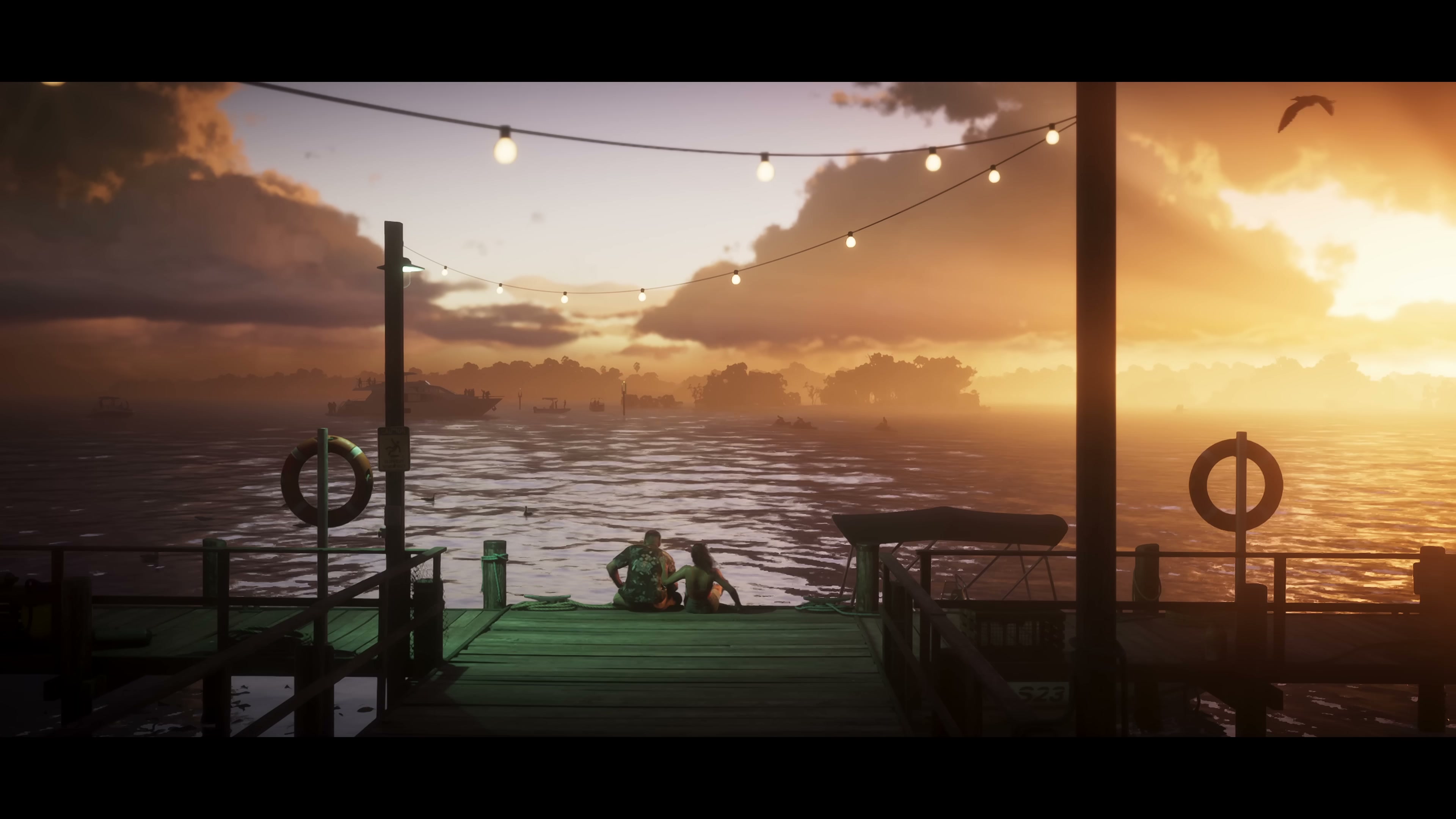
Trailer 2 at 1:23 — physically based sky model, low-frequency volumetric haze, and bounced warm light onto wood surfaces. Sunset rendering is one of the clearest places to see the engine difference.
Grand Theft Auto VI Trailer 2 · timestamp 1:23 · © Rockstar Games / Take-Two Interactive · Reproduced for editorial commentary under fair use. Retrieved May 21, 2026.
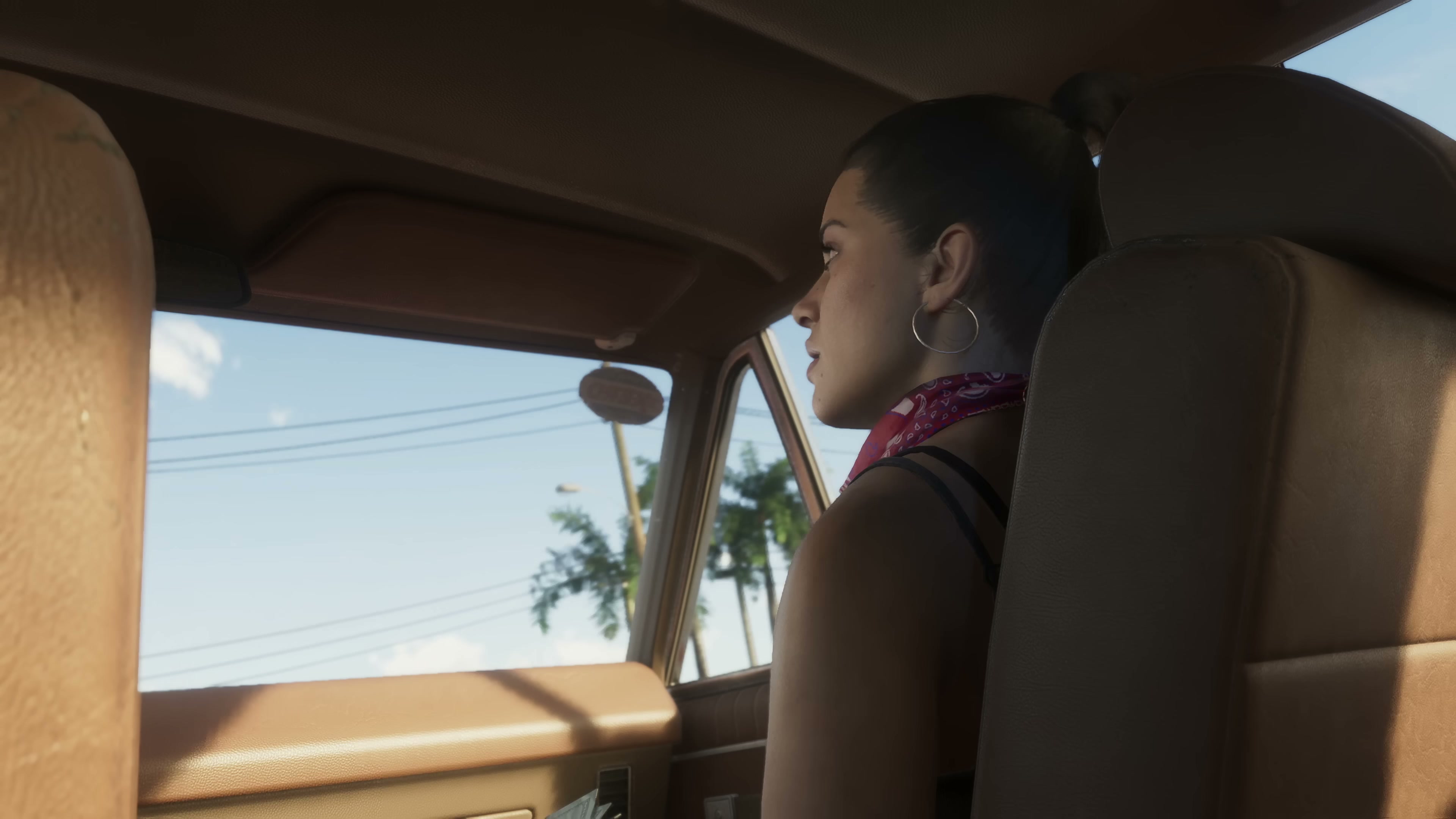
Trailer 1 at 1:02 — fabric weave on the bandana, fine flyaway hair strands, and accurate ear-cartilage translucency in direct sun. Compare against the polygon-flat character lighting of GTA V (2013).
Grand Theft Auto VI Trailer 1 · timestamp 1:02 · © Rockstar Games / Take-Two Interactive · Reproduced for editorial commentary under fair use. Retrieved May 21, 2026.
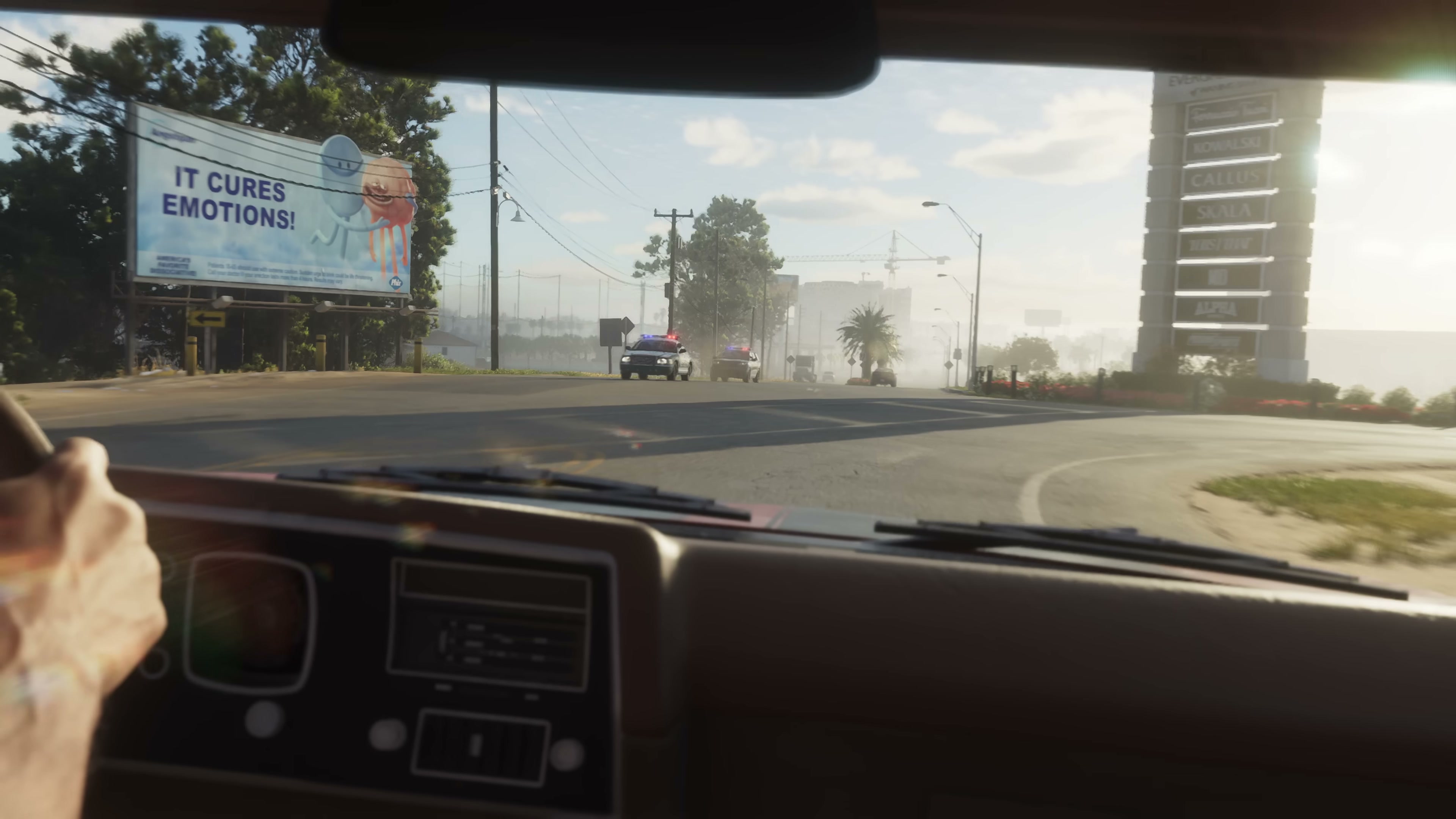
Trailer 1 at 1:00 — first-person interior lighting samples ambient sky colour, billboard text is legible at distance, and tyre contact shadows hold under harsh light.
Grand Theft Auto VI Trailer 1 · timestamp 1:00 · © Rockstar Games / Take-Two Interactive · Reproduced for editorial commentary under fair use. Retrieved May 21, 2026.
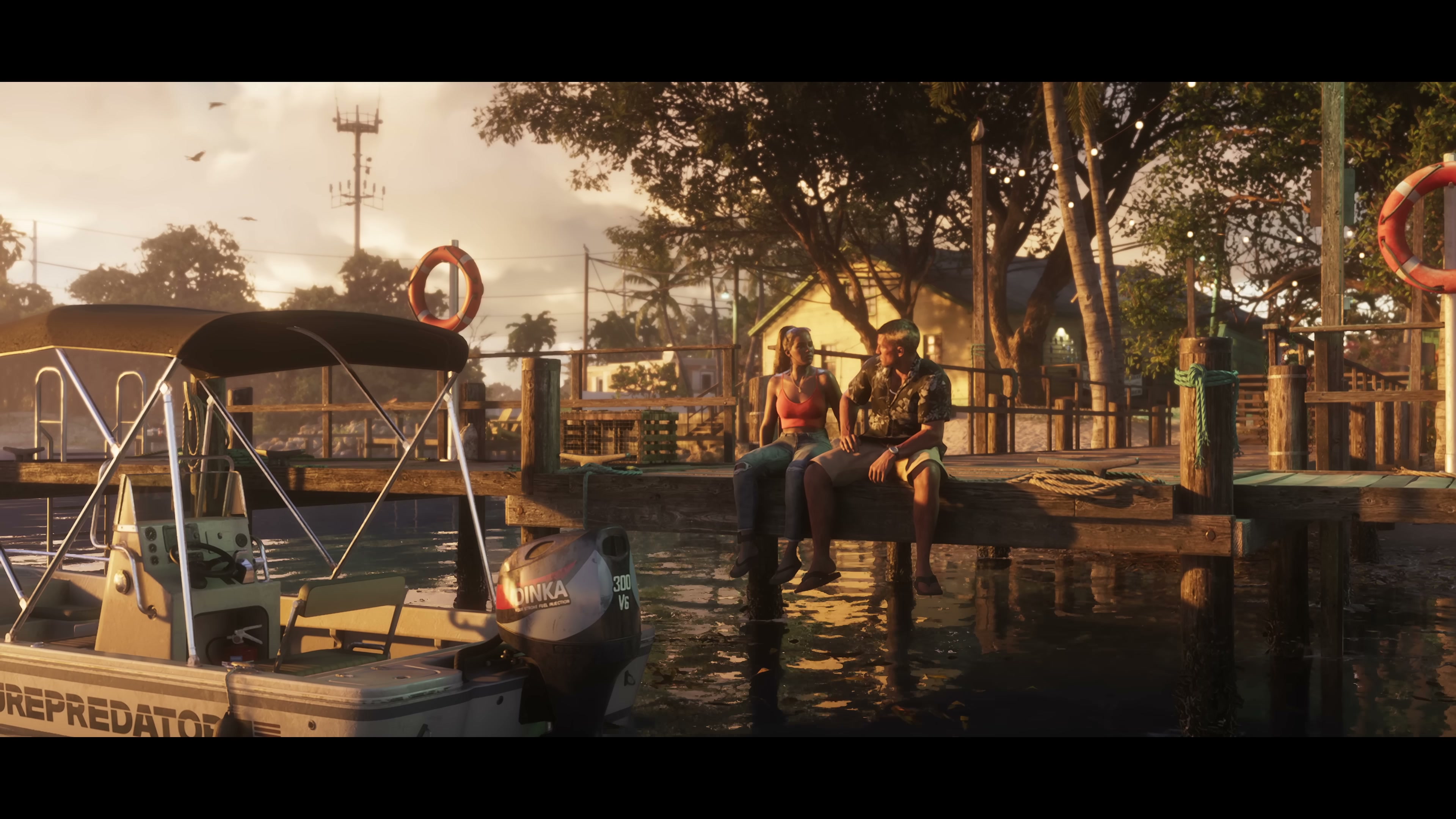
Trailer 2 at 1:21 — material response across wet wood, painted hull, metal railings and chrome trim within a single shot demonstrates the unified PBR pipeline.
Grand Theft Auto VI Trailer 2 · timestamp 1:21 · © Rockstar Games / Take-Two Interactive · Reproduced for editorial commentary under fair use. Retrieved May 21, 2026.
YouTube sources analyzed
- Digital Foundry — Grand Theft Auto 6 Trailer 2 Tech Breakdown - Incredible Realism, Impressive RT, Astonishing Detail (27:11)
- Digital Foundry — Grand Theft Auto 6 Trailer 2 Tech Breakdown - Incredible Realism, Impressive RT, Astonishing Detail (22:10)
- Digital Foundry — Grand Theft Auto 6 Trailer 2 Tech Breakdown - Incredible Realism, Impressive RT, Astonishing Detail (19:47)
- INTER — Why GTA 6 Graphics Is INCREDIBLE.. (0:04)
- INTER — Why GTA 6 Graphics Is INCREDIBLE.. (1:45)
- INTER — Why GTA 6 Graphics Is INCREDIBLE.. (8:32)